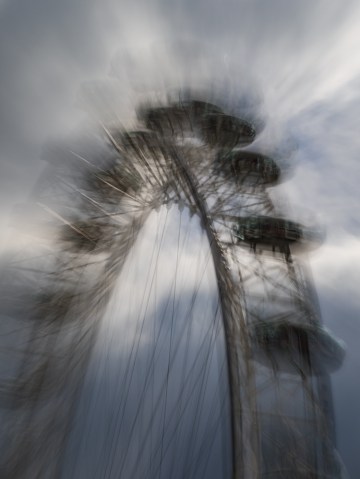
London Eye – Fuji 50-140mm
A combination of illness and family commitments means my Fuji cameras haven’t seen much action over the last month or two, but a couple of weeks ago I was booked on a Light and Land ‘Impressions of London’ workshop with Valda Bailey (Twitter – @tanyards) and Doug Chinnery (Twitter – @dougchinnery) and really didn’t want to miss it. Although I have been taking photos for over 50 years, and feel pretty confident with landscape and urban subjects, I’ve sensed my photography was in something of a rut lately and wanted to try a different approach. So off I headed to London, slightly intimidated by the joining instructions that stated that tripods were not allowed and would be ‘thrown in the Thames’! The reason for this became obvious fairly quickly – this workshop was all about experiencing different techniques like Intentional Camera Movement (ICM), Multiple Exposures and Zoom Pulling, and without the ‘straightjacket’ of a tripod, and the front-to-back sharpness that most photographers are programmed to produce, there would be ample opportunity for creativity and abstract impression. And, boy, was it a different experience!
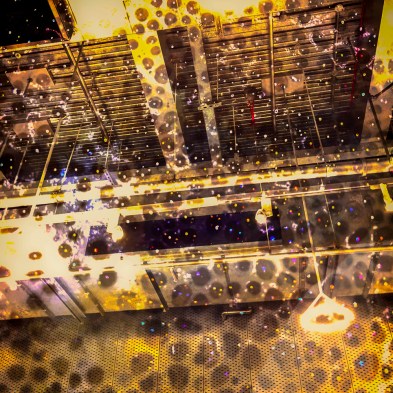
Tate Modern Café – iPhone 6
From the outset, it was clear this was going to be a great day; the weather was kind – mainly sunny with cloudy intervals; the location was great – the South Bank near Tate Modern; Doug and Valda were great tutors, and it was a small but enthusiastic group, keen to learn new techniques. After our initial briefing, where it became obvious that my Fuji X-T1 would have some shortcomings (more on this in a moment) we all worked individually to try and capture images that broke all the conventional rules, but still worked.The instructions were clear – experiment, take lots of photos, look for unusual angles, textures, colours and combinations. Try to build up images from different elements that complimented one-another in some way. Overlay patterns and abstracts on defocussed main images, and think about how images could then be further worked on via post-processing.
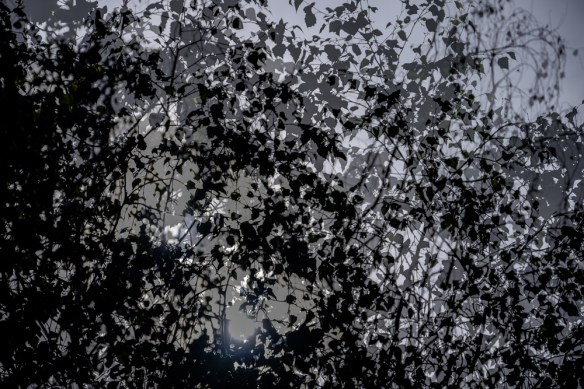
Trees, South Bank – Fuji 16-55mm
So the start point for me was multiple exposure images and this is where the limitations of Fuji cameras compared to Canon and Nikon DSLRs became apparent. Some of the Canon cameras can take up to 9 shots to create a single image. Not only that, but each is created as a RAW file, the individual shots making up the image can be saved individually, and there are multiple modes for blending the images together (like the layer blend modes in Photoshop). The Fuji cameras (X-T1 and XT10 anyway) are much more simplistic – only 2 exposures, a single ‘general’ blend mode, and the only image saved is a JPG of the multiple exposure itself – no original files to go back and have another go with at home… Although this was clearly limiting on the day, I did nevertheless manage several multiple exposure images I was pleased with. Maybe more sophisticated multiple exposure options could feature in a future Fuji firmware upgrade?
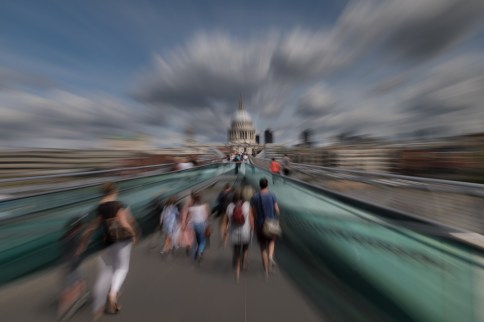
Millennium Bridge – Fuji 16-55mm
Next was Zoom Pulling – twisting the zoom ring during a shot. I found that exposures around 1-3 seconds worked best for this technique – too short an exposure meant there was little effect, while too long an exposure meant all detail was lost. This is a pretty well known and often over used technique, so to my mind needs to be used with care. First time I think I’ve used it though, and some interesting results, especially with quite bold subjects.
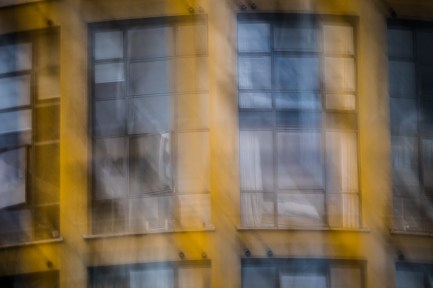
South Bank Apartments – Fuji 50-140mm
Intentional Camera Movement (ICM) is exactly that – moving the camera side to side, up and down, backwards and forwards, or twisting it, all during the exposure. This can create weird and wonderful shapes, with these images used alone, or as part of a multiple exposure final image. One interesting thing I found was when using my 50-140mm lens with the image stabilisation switched on. During exposures of 2-3 seconds, providing the camera was not moving too quickly the IS would ‘lock on’ several times during the shot, giving the appearance of a multiple exposure – quite a pleasing result in some cases.

Golden Jubilee Bridge – Fuji 50-140mm
These techniques (and Valda is a master) are becoming popular, as evidenced by the fact that this month’s UK photo press are carrying a couple of articles about it, so its definitely here to stay. We were of course mainly shooting architecture and urban views, but I can see it would work equally well with landscapes, nature and even macro. What is rather good is that you don’t need to carry a complete bag of gear (as I did!) to capture these images – a mid range zoom lens is sufficient, and no real need for the highest resolution sensor either. I did find that switching filters to get the correct long exposures during changeable light was tricky – I think a variable ND filter would probably be quite helpful here.
So, I have several hundred images from the day – a few of which I am happy with as they stand, and a good number that can be worked on, either individually or combined in Photoshop. I can’t wait to get out and try these techniques again – its not often you learn something new after 50 years of doing pretty much the same thing!
Thanks to Doug and Valda (and Light & Light for their great organisation) for a super day out, and a new creative angle for me to further explore!
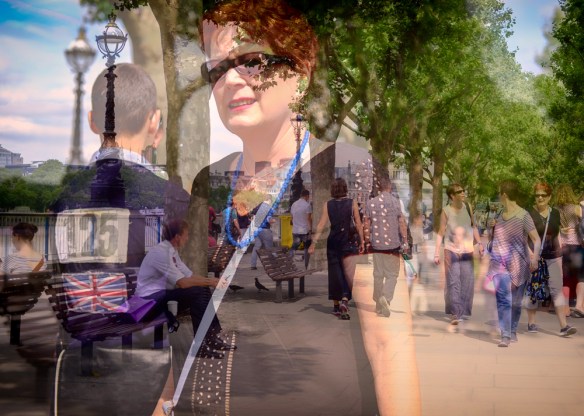
South Bank – Fuji 35mm f2
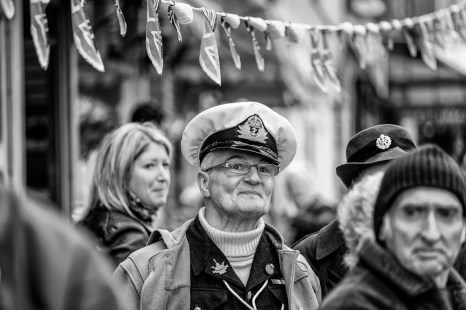 Popped along last week to the 1940s Festival held in Colwyn Bay, North Wales. For two days over the weekend, the town embraced the look, sounds and even the smells of the 1940s, with many different displays, and hundreds of people dressed in period clothes. There were displays of wartime foods and rations, fighting vehicles including armoured cars and jeeps, and of course soldiers, sailors and airmen from Germany, France, Canada and the UK. There was street dancing to ‘Glenn Miller’ style bands, a battle re-enactment and even a ball on the Saturday night (not that I stayed for that!)
 There were some excellent photo opportunities, and it was great to meet up with friends and customers of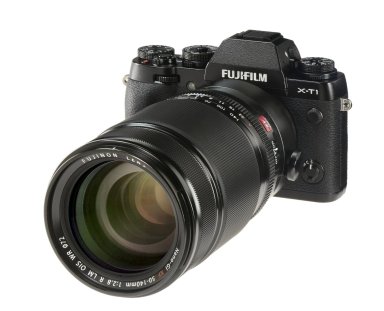
 So, a combination of a bundled deal with the new 1.4x converter, and a hefty discount at last week’s Photography Show was too much to resist, and I came home with one! Unboxing it did reveal just how ‘chunky’ this lens is – it reminded me of my 70-200mm f2.8 Nikon lens, albeit still quite a lot smaller than that brute. Mounted on my X-T1 though (without the detachable tripod foot) it’s beautifully balanced, and the controls are so smooth. The effect of the image stabilisation is obvious even just looking through the camera viewfinder, and the focussing is really fast.
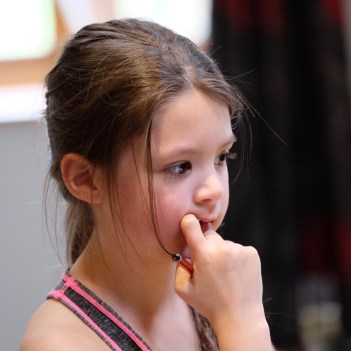 A combination of lots of other things to do, and poor weather this week means I haven’t been outside yet with the lens, but these are a couple of shots taken indoors. They are wide open (f2.8 of course), 140mm, and 1/125th sec, which is usually ‘marginal’ for getting a sharp photo at this focal length, but you can see just how sharp the images are.
 Nigel Young