Always Have A Camera Ready…

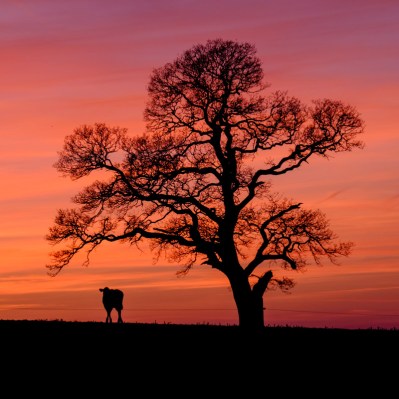
XT102980Last night was a perfect reminder – we were sitting at home having a drink when OH noticed the sunset colours developing and the cows at the top of our garden.  Encouraged by her (it was hard to tear myself away from a Sauvignon Blanc, even for a photo), I grabbed my Fuji X-T1 and raced to the top of the garden.  Managed to get maybe 6 shots off while the cows were suitably juxtaposed with the big old oak tree, and before the colours faded. No time to set up a tripod, all shots were taken with the camera balanced on a fence post.

Key thing for me, and the moral here, is to always have a camera set and ready to go – my X-T1 ALWAYS goes back in its bag with battery fully charged, fitted with the 18-135mm lens, set to Auto ISO 3200, and everything else on Auto. That pretty much guarantees a shot in all circumstances and is a good place to start.

For the technically minded – images were shot in RAW, then processed in Lightroom with a Fuji Velvia preset to boost the colours, a little clarity added, then cropped to suit.

Zoom or Prime Lenses?

This week I’ve been following a lengthy thread on a photo forum about the merits of zoom vs. prime lenses. Quite heated at times, the arguments debate the convenience of zoom lenses (less weight overall, speedy change of focal length) with the quality of zoom lenses (wider apertures and sharper images generally). The zoom camp accuse prime supporters of being ‘pixel peepers’ – those only interested in the absolute technical performance of a lens rather than the ability to take good photos, while prime supporters maybe imply that zoomers are too lazy to walk backwards or forwards to best frame their photo.

Of course, these arguments are more or less valid depending on the situation; in a fast moving reportage situation the ability to quickly zoom in on action may be the difference between getting and missing a vital shot, while a landscape photo may benefit from a little extra sharpness that a prime lens can give if used carefully. One new argument (to me anyway) is that zoom lenses stifle creativity – its all too easy to just blast away without thinking about how best to frame a shot, and indeed if a subtle change of perspective will enhance a photo.

This got me thinking – since switching from a film camera to digital a few years ago, I’ve mostly used zoom lenses, and I have to say I haven’t always been happy with the photos I’ve taken.  Certainly the proportion of ‘keepers’ – those photos good enough for me to want to retain them even if they are not my absolute favourites, has dropped. Now of course one big factor is the negligible on-cost of each photo taken with digital, compared to the £1.00+ cost of each 6x7cm transparency – with film, you had to make every shot count, whereas with digital the temptation is to just blast away, and select the best later. But there’s more to it than that – even when I’ve taken a number of digital photos of a given subject, I’ve not always been satisfied that I’ve got ‘that’ perfect picture, even though I may have tried any number of exposure or focus combinations. It’s not necessarily that the images aren’t sharp or whatever, they just don’t quite work…

So maybe there’s something about using prime lenses that helps you take better pictures – perhaps its because you need to take time to frame the shot, moving backwards and forwards until the elements are just right, or maybe it causes you to look at a subject differently? So this week, to try and get a feel for this, I went out for an afternoon with JUST prime lenses to see how I got on. Subject was ‘The Roaches’ – a wind-carved outcrop of gritstone rocks in the Peak District National Park about 4 miles north of Leek, Staffordshire and 8 miles south of Buxton, Derbyshire. The weather wasn’t perfect – fairly cloudy for most of the afternoon, and also hazy following a few warm days.

This slideshow requires JavaScript.

Anyway, I walked/climbed up to the summit, along the ridge to Docksey Pool and back – a couple of hours in total.  Armed with 14mm, 23mm (borrowed), 35mm and 60mm lenses, and a lightweight tripod which I didn’t actually use, I really enjoyed the more leisurely pace that shooting with primes enforces, in particular adjusting my position to best frame each shot, and taking the time to use a graduated filter to balance/darken the sky when needed.  I mainly used the 14mm wide-angle, but also took a few shots with the 23mm and 35mm, and have to say I was amazed at the sharpness and clarity of them.  I can’t claim they are masterpieces, but I’m sufficiently happy to want to continue the experiment. A few of my favourites from the day are here.

A Tale of Three Flashguns

Coming from Nikon to a Fujifilm ‘X’ camera, the choice of flashguns appeared somewhat limited – something Fuji have since acknowledged and are working on.  None of the complete flash systems that Canon and Nikon offer – just 3 flashguns. Firstly the diminutive but expensive EF X-20 model with a modest guide number of 20, no bounce flash facility, and it only works in TTL mode off-camera using a cable.
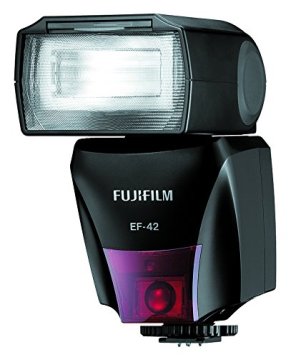
ef-42

Fujifilm EF-42

Then comes the EF-20 model, again with a guide number of 20, but this time with a bounce (but no swivel) facility. Lastly the EF-42 model, really just a rebadged and slightly re-engineered Sunpak unit, it does at least do bounce and swivel flash, and has a guide number of 42, but for off camera TTL use again needs an extension cable. It’s quite bulky for its power and limited functionality, and the menus aren’t particularly intuitive, but it was the best on offer at the time so I bought one.

It turned out to be ‘ok’ for general use (not that you need flash a lot for everyday photography – the amazing low light sensitivity means the Fuji ‘X’ cameras pretty much see in the dark.) Family and group photos came out reasonably well, especially if the flash was bounced off a wall or ceiling.  Exposures weren’t always dead accurate on auto, but not bad.

HOWEVER, where I really struggled was with product photography, something I do from time to time. It really needs much more than just bounce flash to create consistent lighting across a range of products, and the relative lack of control means lots of ‘bright’ spots or indeed reflections.  Shooting through an umbrella or softbox is pretty much the only way to go, but this means off-camera flash. The extension cable route worked, but was a PITA – the longest off-camera lead I could find (has to be a Canon OC-E3 type) was a coiled type that only stretched to 1m or so before it pulled my lighting stand over, so this seriously compromised my camera and shooting position. Then the lack of power really showed up shooting through an umbrella, and I found I needed to switch to manual operation anyway as the exposures were inconsistent because the products varied so much in colour/reflectivity and this affected the TTL flash metering.
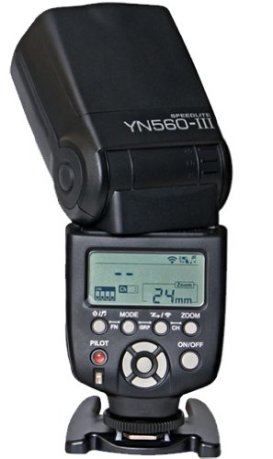
yongnuo

Yongnuo 560

A couple of Yongnuo RF-603C II flash triggers overcame the extension lead and stand instability problem – one on top of the camera set to Tx mode, and the other underneath the EF-42 flash set to Rx. Triggering was 100%, and I completed the assignment without further problems.  I was using 2 cameras simultaneously on each shot so had to switch the RF-603 transmitter between cameras for each shot – awkward, but ok.  A bit more power would also have been useful, and next time around I will probably want to use an additional flashgun for some fill-in.  So what to do next?

Enter the Yongnuo YN560-III speedlight – an inexpensive manual only flashgun with a guide number of 56, and bearing a marked resemblance to the ‘old’ Canon 580 speedlights. At under £50 (yes – £50!) and some good reviews, it seemed worth a try.  It will operate on-camera on its own or triggering other YN-560s, or can be triggering by the above RF-603s. It’s fairly simple to set up, and with the recently announced YN560-TX controller/trigger, flash output for single and groups of flashguns can be set remotely. Given the price, these flashguns and triggers are remarkably robust, and the quality seems at least as good as the Fuji brand flashguns. The extra power of the YN560 over the EF-42 makes about 2 stops exposure difference, or the option to still use lower power, but with improved flash recycle times.

There are a couple of other options for 3rd party speedlights (notably the Cactus RF60 and the Godox 850) but both are much more expensive and also have their drawbacks, whereas my £150 investment in Yongnuo gets me 2 speedlights, 2 triggers and the 560-TX controller. This gives me the 2 flashguns, triggers for 2 cameras, (3 if I use the controller on camera instead of off-camera.) Everything I need for a mini-photo studio in terms of flashguns!
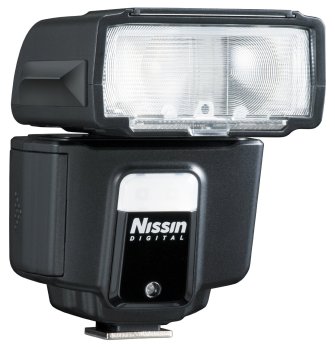
nissin

I have to say I am completely knocked out by the Yongnuo gear – I was sceptical about quality and performance given the price (my ‘old’ Nikon SB flashgun were upwards of £300 each new!), but there is absolutely nothing wrong with these. The design and operation is exactly what is promised, the fit and finish of the component parts is good, and I’ve seen no significant complaints regarding reliability or longevity.

What about the EF-42? Well, it is now going on eBay and should pay for at least 1 of the YN560s.  But what about a nice small on-camera flash for those family and group photos where auto operation is needed? That’s covered too – the newly announced Nissan i40 has just arrived.  It’s 2/3rds the weight of the EF-42, around half the bulk, and looks so right on a Fuji camera. It’s SO easy to operate, and also to use flash exposure compensation when needed.  Its actually small enough to carry in my everyday bag, which is a real bonus. The following shows just how different these 3 flashguns of mine are in size:

So until Fuji (or someone else) brings out a significantly better flash system at a decent price, I’m set up – the Nissan i40 for everyday and event photography, and a set of the Yongnuo’s for ‘studio’ and setup work with umbrellas, soft boxes and reflectors. I’m happy with that, (and haven’t spent the earth!)
The Under-rated Fuji X-M1

The little Fuji X-M1 tends to be overshadowed by its ‘big’ brothers – particularly the X-T1 and X-Pro1 and the iconic X100S. It’s relatively inexpensive (I picked mine up used for £160), and only has an LCD screen on the back, no electronic or optical viewfinder. The construction is a little more ‘plasticky’ and the controls with the PASM and mode dial are somewhat reminiscent of cheaper compact cameras.  However, the heart of the camera is the same 16Mp sensor used in the X-T1 etc and it takes the same fabulous XF lenses, so in the right hands, and with a few caveats, is capable of the same results.  I picked mine up to keep as a backup to my main camera body and didn’t really envisage using it on a regular basis. However, pair it with the diminutive 27mm lens, and it’s a cracker! Its just 12 x 6.5 x 6cm so actually smaller (and lighter) than the X100S! It really does fit easily in a jacket pocket, and I took it into a concert without security even noticing it…DX141123-2

So given that it is smaller than my X100S and I felt I needed to get to know the camera better, I took it out with me last night, just on the off-chance of some photos. What a revelation! Used wide open at f2.8, and with auto ISO set to 3200 max, it performed brilliantly in what seemed like near darkness.

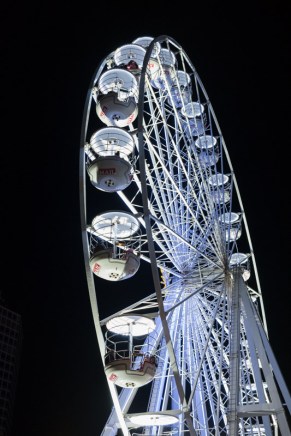
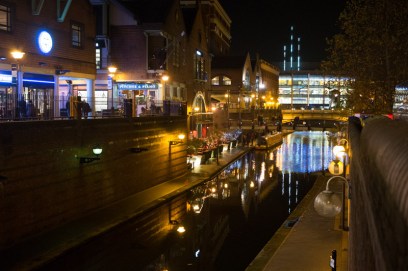
Walking around Centenary Square in Birmingham, the AF locked on perfectly on the Giant Wheel and the new Library of Birmingham, and propped against a wall a 1/20th sec photo of the canal was adequately sharp. Inside the NIA Arena, I even managed some decent concert photos. What is incredible about all these Fuji cameras, and the X-M1 is no different, is the high ISO performance – it retains an amazing amount of shadow detail, with very little noise.  I’ve had some far more sophisticated cameras in the past, but none can equal this low light performance. It almost doesn’t matter how dark it is, just shoot away and the camera sorts it out. The only ‘tweak’ I made was to the concert photos where it was burning out the highlights, so I dialled in one stop of under exposure and that fixed it.

DX141123-5Don’t forget also that the tilting LCD screen is great for low level or overhead shots, and it even has a decent little pop up flash built in. It’s wifi enabled too, so photos can be uploaded directly to a smartphone, or printed on the new Fuji Instax printer. It may not have the faster AF that the X-E2 and X-T1 have, but when it does find focus is generally locks on accurately; unless you are capturing sport or other fast moving subjects, it isn’t really an issue. It’s a credit to Fuji that they have managed to pack the image quality of their more expensive models into what is a very affordable entry level camera that is fully compatible with the whole XF lens range.

I’m really happy with my little ‘pocket-rocket’ – it’s a great combination with the 27mm lens, and there’s always the option to pair it with any of the other Fuji XF lenses – even with the 18-55mm zoom lens it is still very handy for travelling light.

This slideshow requires JavaScript.

EDIT: Although I really liked the compact form of the X-M1, ultimately I struggled without a viewfinder, so sold the X-M1 in favour of its bigger brother – the X-E2. Only slightly larger, it has a better build quality, great viewfinder, and much faster AF, so a winner alround. Thanks to eBay, I sold the X-M1 for virtually what I paid for it, so a win:win there.

Travel tripod mini-review

My Manfrotto tripods have served me well over the years, and with their height, stability and quick release ballheads, were perfect for my DSLR cameras. Moving to a smaller camera system (to reduce the strain on my back!) has highlighted just how heavy these tripods are, and increasingly I’ve not wanted to carry a tripod at all when out walking. So perhaps it was time to look for something smaller and lighter, and I was attracted by the new style of travel tripods weighing around 1kg and folding down to just 30cm (12″) or so long – small enough to go inside a backpack.

There are at least 6-7 brands that all look quite similar – they all have legs that fold back on a centre column, a small ballhead, and are typically around 130cm tall when fully extended. Prices run from about £80 to £140. The first I tried was the MeFoto Backpacker at £119 from Amazon. It had received very good reviews so seemed a good buy. First impression was indeed very favourable – 1-2kg in weight, 130cms tall extended, a fixed centre column with a rising inner column, a ballhead with an ARCA-Swiss style quick release, and twist lock legs.  There is a hook in the centre to hang a bag or weight for extra stability, and it all comes in a carry-bag.

71hn3EM0ZZL._SL1500_

Hahnel Triad C4 Tripod

Considering how light it is, it was remarkably stable, and easily took the weight of my Fuji X-T1 with zoom lens.  Several observations from the outset –

1. The centre column is fixed in position, so there is no option to use the tripod with the ballhead sitting immediately on top of the legs – its most stable position. This also means that if you want to carry the tripod on the side of a backpack, it is around 50cms tall with the legs retracted, but in the unfolded position.  Likewise the column cannot be reversed for ultra-low shots.

2. There is no means of retaining the legs closed together, so any tripod holder needs to take account of this. Also, with 4 sections to each leg, that means a total of 12 twist actions to both unlock, and then relock the legs – miss just one when you are retightening the legs, and the tripod will collapse to one side. I prefer the flip locks on my larger Manfrotto tripod.  There are only two ‘in use’ positions for the legs, a fairly upright position, and the usual very splayed position for low level work.

3. By far the biggest problem for me was the camera mounting plate – fitted to 714053c8qaL._SL1500_my Fuji X-T1 it obscured the access to the battery compartment, so when out shooting in a muddy field I had to remove the camera from the tripod, then remove the plate and re-attach it, just to change a battery. This isn’t a fault of the tripod/ballhead – it occurs on all quick release heads because of the proximity of the battery compartment to the tripod bush on the Fuji.  I tackled this issue by getting a Fuji X-T1 Small Grip Plate – essentially a flat plate that screws onto the bottom of the camera (but doesn’t obscure the battery compartment) and provides an ARCA/Swiss style dovetail mount which fits perfectly on this tripod.  Problem solved!

However, the points above caused me to look around, and I dropped on an Amazon ‘lightning deal’ for the Hahnel Triad C4 Tripod and Head, for an amazing £39.99 (usual Amazon price £72.00, and on sale at Wex for the RRP of £99.99).  What a steal! This is so similar to the Mefoto tripod it’s untrue – one is definitely a copy of the other. Given the much lower price, I wasn’t expecting much, but its equally good (with one exception below…)  The height and weight are much the same, the centre column is adjustable and removable, so great for low level work, and slightly better stability in the fully ‘down’ position.  There is also an intermediate position for the width of the legs – great on a windy day, or or uneven ground

The problem however is that the ARCA/Swiss ‘style’ camera plate is some 5mm wider than the standard 37/38mm standard for these.  No problem if you just use this plate, but remember I now have the special camera plate – you guessed, it doesn’t fit this ballhead. Not great. After trying a different ballhead,  I sourced a replacement plate and clamp to fit the original Hahnel ballhead for approx £5.00 (from China).  It needed a new 6mm countersunk bolt to fit it, and a little Araldite to take up some slack in the mount, but it really works a treat.  So, job done, and total cost of this new setup  is just £45.00.  What a bargain!

Bottom line is that for a very modest price, it’s possible to buy a lightweight tripod good enough for most travel shots, and that weighs less than half of a conventional tripod. Definitely a good investment…

EDIT: This tripod is very much my ‘trekking’ tripod – if I’m close to the car and don’t mind the extra weight and bulk, one of the larger Manfrotto units is clearly more stable, but this one definitely has it’s uses.

Handy bag for an X100S?

Is there ever such a thing as a perfect camera bag?  I don’t think so, and I’ve got a cupboard full of ‘nearly perfect’ bags at home to prove my point. My little Fuji X100S camera has been interesting from that perspective – its small enough to be handy for street and candid photos, but too big to go in a coat pocket. The Kata and Billingham bags I have tried for it are fair enough – adequate protection, and room for extras like batteries and filters, but somehow they are ‘awkward’ to use.  The Billingham Hadley Digital looks like a camera bag, and its not the easiest to slip the camera in and out of, and the Kata doesn’t hold the camera securely unless it’s all zipped up, so a compromise between accessibility and security.

Along came the Lowepro Streamline 150, and this is proving to be interesting – it looks like a Messenger or ‘man-bag’ but has plenty of room for the X100S, WCL converter and spare batteries etc. Crucially there is also room for a phone, keys, a notebook, and other odds and ends, so it’s a take anywhere bag that just happens to double up as a great camera bag. Brilliantly the camera just slips into its place  – secure enough anyway in its foam padding, but with the option to close the zip fastener on the front of the bag for extra safety.

Time will tell how it works out, but for now I’m happy to carry a lightweight shoulder/messenger bag with my camera safely ensconced, but available at a moment’s notice for that elusive shot.

EDIT: The bag is still going strong!  Its become my ‘carry-everywhere’ bag, and the X100S is always in it ‘ready to go’, with a fully charged battery, a spare battery and memory card, and everything set to Auto and ISO auto 3200. I’ve sold the WCL converter as I was never bothered to use it – if I want different lenses I just take my other camera. For ‘occasional’ use the camera just has a wrist strap fitted, or for longer sessions I put a neck strap on. My iPad mini fits in the bag for days out too.

EDIT:EDIT Almost a year on, and the bag is still in use! The X100S has given way to a Fuji X-E2, which with a 27mm lens is my ‘carry-everywhere’ camera. It will just about go with an 18mm lens, but too tight with a 35mm or with a grip fitted. For that I use a larger bag…