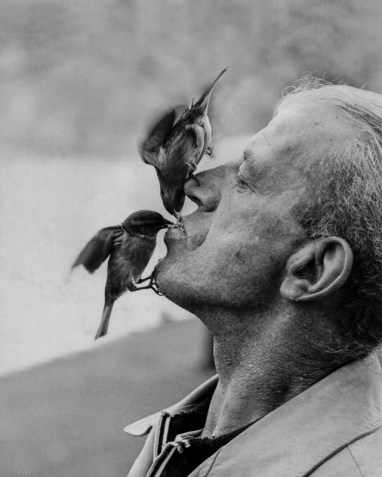
Feeding the Birds, in 1974!

AN74XX-1

Nikkormat FTn – Ilford FP3

Yes, 1974 or thereabouts, I can’t remember the exact date. Taken on a trip to London, I think on my old Nikkormat FTn camera, probably with a Nikkor 105mm f2.5 lens and FP3 film. The negative perished years ago but I found a very damaged and torn 10×8 print a couple of years ago, scanned it, and spent hours restoring it.

One of our friends back in the 1970s was Chief Photographer at the local newspaper (the Wolverhampton Express & Star), and managed to get the photo published for me. I got a series of calls from other newspapers, and it eventually made it into the Daily Telegraph and a couple of other UK dailies via a picture agency.

One day I received a call from the London ‘stringer’ for the Florida-based National Enquirer who was interested in publishing the photo in the US. (Interestingly, his name was Fred Pye, and at the time married to the singer Kathy Kirby…)  I think I got paid $50 (a lot of money then!) for them to use the photo  – its the only photo I’ve ever been paid for… lol

Take a walk…

My dear wife spotted a FREE photo walk at the Dudmaston National Trust property in Shropshire (UK) and encouraged me to try it. I am so glad I did!

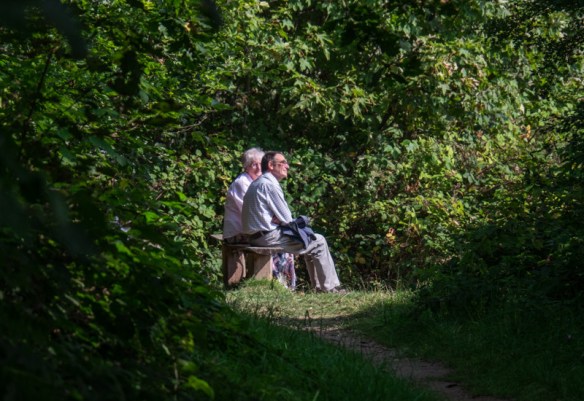
Accompanied by a volunteer photographer at the estate, a bunch of around 12 of us walked around the site for a couple of hours while he pointed out things of interest and good viewpoints. All this was at a leisurely pace, so even though I was the only one using a tripod, it didn’t seem rushed.  It wasn’t the best weather/light – around midday in September, cloudless sky and slightly hazy, but this was fine for the woodland shots, and needed a bit of post-processing to bring out contrast in the wider more open views.

XT101188

Taking it easy…

I really enjoyed using the Fuji 18-135mm lens – its a fair bit heavier than my ‘old’ 18-55mm, but I only switched lenses once during the day (and that was to a wider angle lens).  There’s been talk about this new lens not being as sharp as the 18-55mm, but so far it works for me.

All in all a great session – well lead by volunteer Matthew, a good venue, and minimal cost, just the standard £6.60 entrance fee to the property.  Definitely worth looking for other similar events – there are several over the next few months in the Shropshire/Cheshire area.

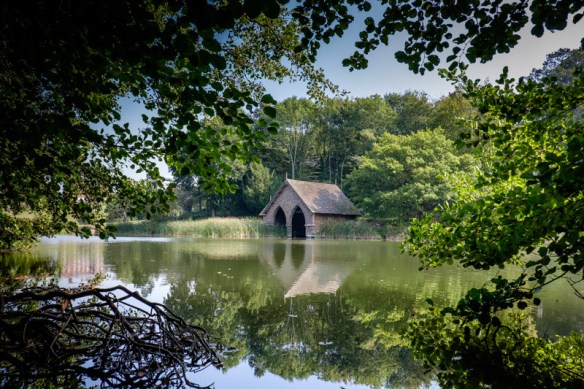
Boathouse - Dudmaston NT

The  boathouse at Dudmaston

Dudmaston is situated on the A442, approx 3 miles south of Bridgnorth, and is run by The National Trust.

Do I need graduated filters?

There’s a groundswell of opinion that the way to deal with the extremes of contrast in sunset and sunrise images in particular is to use a graduated ND filter. The principle is simple – set the filter so the darker part covers the brightest part of the image – usually the sky, and this then ‘holds back’ the light, giving a more balanced image. Sounds simple, but not so easy in practice. A tripod is essential to hold the camera still while the filter is correctly placed. That’s after you’ve worked out how strong a filter to use, and whether its a hard ‘grad’ (i.e. a quick transition from light to dark) or a soft ‘grad’ if a gentler transition is required. There’s also the small matter of carrying around the filters (up to 6 in a set) and the holder and adapters for different lenses, not to mention the cost of the filters themselves – could be £200 +.

Most decent digital cameras allow you to store the RAW image from the chip, and its generally possible to get quite a decent dynamic range by careful post processing – however with a really wide exposure range like the image below, that’s still not going to do the trick.

A very practical alternative is ‘exposure stacking’ – take one image exposed for the lighter parts of the scene (the sky here) and another exposed for the darker foreground detail. Then combine the two images in a programme like Photoshop to take the best bits of both. The image below was from images with 5 stops difference in exposure – far more than even grad filters could easily copy with, and was merged together in just a few minutes. Its a really practical way to cope with wide exposure differences – just remember to use a tripod so the 2 images correspond!

DX121021-60

EDIT: Since writing this blog back in May 2014, I’ve actually invested in a set of grad filters. I don’t use them that often as its possible to wring a lot of detail out of Fuji RAW images, but there are times when they definitely help.

Handy bag for an X100S?

Is there ever such a thing as a perfect camera bag?  I don’t think so, and I’ve got a cupboard full of ‘nearly perfect’ bags at home to prove my point. My little Fuji X100S camera has been interesting from that perspective – its small enough to be handy for street and candid photos, but too big to go in a coat pocket. The Kata and Billingham bags I have tried for it are fair enough – adequate protection, and room for extras like batteries and filters, but somehow they are ‘awkward’ to use.  The Billingham Hadley Digital looks like a camera bag, and its not the easiest to slip the camera in and out of, and the Kata doesn’t hold the camera securely unless it’s all zipped up, so a compromise between accessibility and security.

Along came the Lowepro Streamline 150, and this is proving to be interesting – it looks like a Messenger or ‘man-bag’ but has plenty of room for the X100S, WCL converter and spare batteries etc. Crucially there is also room for a phone, keys, a notebook, and other odds and ends, so it’s a take anywhere bag that just happens to double up as a great camera bag. Brilliantly the camera just slips into its place  – secure enough anyway in its foam padding, but with the option to close the zip fastener on the front of the bag for extra safety.

Time will tell how it works out, but for now I’m happy to carry a lightweight shoulder/messenger bag with my camera safely ensconced, but available at a moment’s notice for that elusive shot.

EDIT: The bag is still going strong!  Its become my ‘carry-everywhere’ bag, and the X100S is always in it ‘ready to go’, with a fully charged battery, a spare battery and memory card, and everything set to Auto and ISO auto 3200. I’ve sold the WCL converter as I was never bothered to use it – if I want different lenses I just take my other camera. For ‘occasional’ use the camera just has a wrist strap fitted, or for longer sessions I put a neck strap on. My iPad mini fits in the bag for days out too.

EDIT:EDIT Almost a year on, and the bag is still in use! The X100S has given way to a Fuji X-E2, which with a 27mm lens is my ‘carry-everywhere’ camera. It will just about go with an 18mm lens, but too tight with a 35mm or with a grip fitted. For that I use a larger bag…