A flying visit to the Lake District this week yielded a couple of hours to get out with my camera. The conditions were not, however, very encouraging – although the forecast was for ‘sunny spells’, it was raining when I parked at the Silverthwaite National Trust car park just off the Ambleside to Langdale road, and it was blowing an absolute hooley (the aftermath of Storm Henry.) Still, boots on and kit in hand I headed down to the path running alongside the River Brathay to see what was possible.
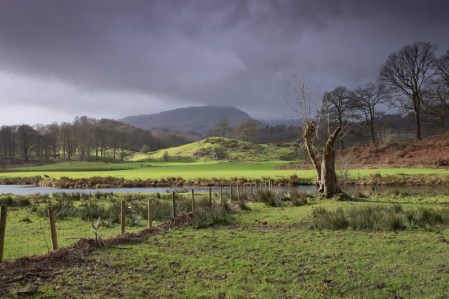 I had planned to try a couple of long exposure images using my new Hitech filter holder, but it was clear it was far too windy for sharp pictures, even with my heaviest tripod set as low as possible. The tops of the fells were shrouded in mist/cloud, but there were some brighter patches in the sky (nothing to actually call sun though…) Anyway, I found a nice view with a fence as lead-in, and set up and waited. After about 10 minutes, it had pretty much stopped raining, and I was rewarded with a few breaks in the cloud. The foreground was nicely bathed in sunlight – only for a few seconds, but enough to get a couple of frames including this one.
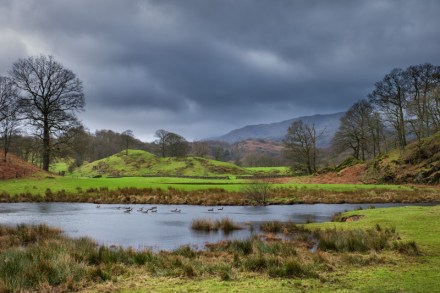 Wandering along looking for another view point, I spotted this family of ducks, and quickly set up. Within a few seconds they had moved into the perfect position in the frame, and as luck would have it, another fleeting moment of sunlight brought the scene to life. Time for one shot only before the ducks had moved on, and the sun had disappeared again!
In the time left, I managed another couple of shots, but as before it was a case of finding something interesting, setting up, and then waiting (and waiting…), and hoping the light would come good. I had quite a few strange looks from walkers passing by, and even a few comments about me just standing there waiting – everyone expects a photographer to be shooting all the time, but there’s absolutely no point if the light isn’t going to make the shot work. Sometimes waiting until the light is right pays off, but so often its a case of returning when the conditions are better. Patience is rewarded (but only sometimes!)


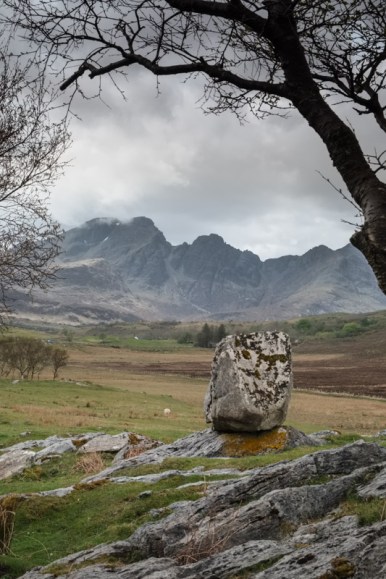
Here are a couple more I managed that morning. All photos taken on my Fuji X-T1 camera with 16-55mm lens, Hitech filter holder with 0.9 ND grad filter, and Manfrotto 055 tripod. RAW images processed in Lightroom, and Viveza 2.

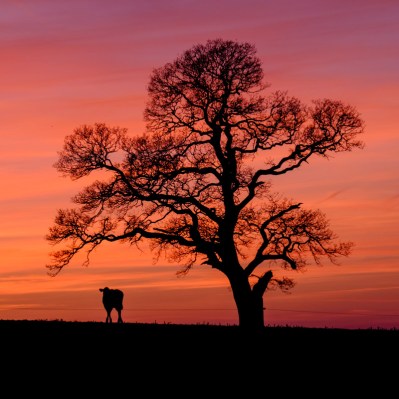 Last night was a perfect reminder – we were sitting at home having a drink when OH noticed the sunset colours developing and the cows at the top of our garden. Encouraged by her (it was hard to tear myself away from a Sauvignon Blanc, even for a photo), I grabbed my Fuji X-T1 and raced to the top of the garden. Managed to get maybe 6 shots off while the cows were suitably juxtaposed with the big old oak tree, and before the colours faded. No time to set up a tripod, all shots were taken with the camera balanced on a fence post.

 Nigel Young