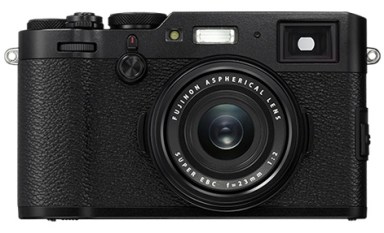
Neil Diamond’s song ‘Hello Again’ from the Jazz Singer film is an expression of enduring love – a need to keep restating loving emotions. My relationship with the Fujifilm X100 series is more of an on/off love affair – an itch I can’t stop scratching, and here we are again…
I bought my first X100 camera, an X100S (’S’ for 2nd generation) back in 2014, largely as a result of seeing Todd Gipstein’s wonderful 1 Mile, 1 Year, 1 Lens video presentation. His 15 minute monochrome picture show was, as the title suggests, a series of photos all taken within the space of a year, and within a mile of his home. I suppose I thought that with a camera like that, I should be able to shoot great photos, unencumbered by lenses and filters and stuff – what I may just have missed is that Todd is a brilliant photographer, and the location for his photo set is the very varied and photogenic New England coastline…
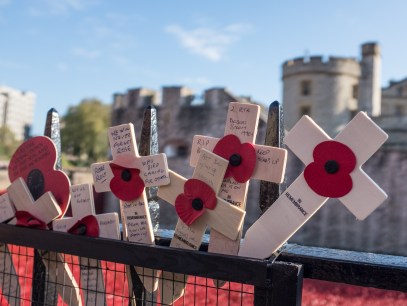
X100S – Poppies, London
Nevertheless, even with my much lesser talent, I did take some photos I was pleased with, and it was a very portable option when I wanted to travel light. I kept the camera for about a year, then let it go when I wanted to get a wider range of lenses for my then Fuji X-T1. After about 6 months, I really missed that little camera’s portability and relative simplicity, so picked up what was then the latest 3rd generation X100T. Looking back, I see I only kept it for a couple of months – I had in mind that having a second body that I could fit my lenses to was going to be more useful than a fixed lens camera, so it got traded in.
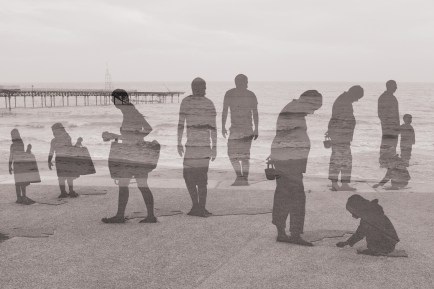
Colwyn Bay – X100F launch day
Fast forward a year or so, and all the Fuji gear had gone, and been replaced with Olympus – a mistaken belief that I could get similar image quality from a smaller camera and lens collection. I got talked into going to the launch event for the new 4th generation X100F in early 2017, and although I rather liked it, wasn’t really tempted to spend the £1200 or so it was priced at. Then in 2018, having dumped most of the Olympus kit in favour of Sony, I borrowed an X100F for a family holiday in France – I was still looking for the best possible quality in a camera smaller than my Sony A7iii with it’s rather large lenses. The X100F was marginally better than the Olympus Pen-F I still had, but rather than get the X100F, I went with the nearest Sony equivalent, an A6300 with a couple of lenses – logic being that these Sony lenses and bodies were all interchangeable up to a point.
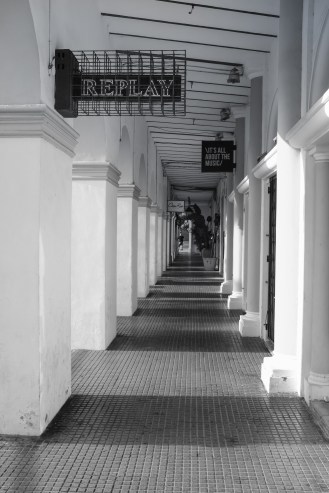
X100F – Ibiza
And that’s more or less where I was until a few weeks back when I realised that this search for a ‘perfect’ setup of larger camera for landscapes and ‘serious’ photography, and a smaller more portable system for travel was taking away all the enjoyment I was getting from photography – I was acquiring more and more gear, and then stressing about what to take with me (my previous blog post highlights this…) I was definitely heading for a complete photographic meltdown and it really was time to get a grip…
So decision made, and hopefully one I will stick with – I’ve slimmed down the Sony A7iii kit to the minimum, and will be keeping that just for landscapes etc, and particularly for locations where I am close to the car – it all still weighs a fair bit! The A6300 and lenses has gone now, and in its place is (you’ve guessed it) an X100F! Nearly new, it came at a good price, and is complete with filter adapter and a rather nice leather case. With a couple of spare batteries and a polarising filter, it’s a great everyday/travel option.
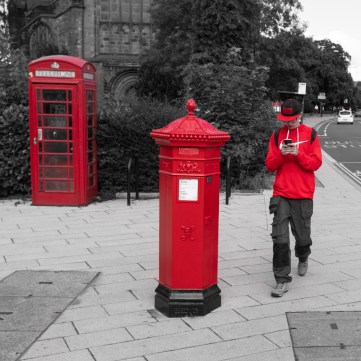
X100F – Shrewsbury
I took it to Ibiza last week (and left the A7iii at home) and was more than happy with it. It’s definitely portable, and the results are very good indeed. I’m getting back into shooting mono and street photography, and really enjoying it – who knows I may yet sell the Sony full frame system and indeed revert to being a ‘one camera, one lens’ guy – not so much a ‘photographer’, more a ‘man with a camera’.
That’s quite an appealing thought!

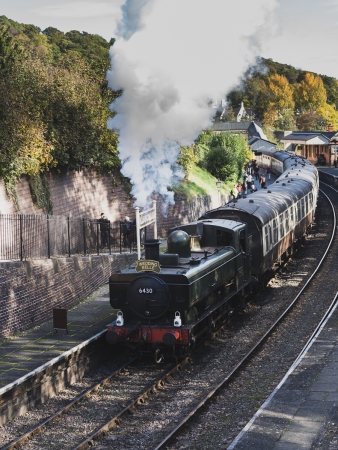 Thanks to those kind people at
 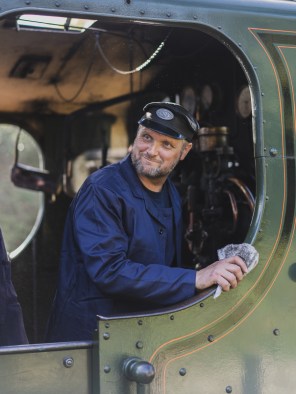 The line now runs for around 10 miles from the beautiful station at
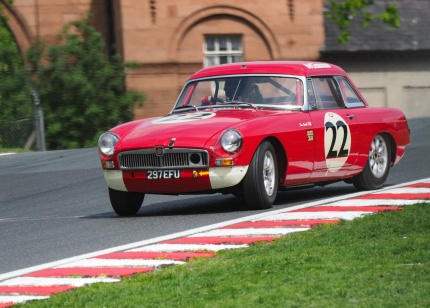 Although I have some reservations about using my Olympus Micro-Four Thirds (MFT) cameras for landscapes, one area where they come into their own is fast action photography like motor sports. The sensor on all MFT cameras is just one quarter the size of a so-called full frame camera, and although they can still deliver file sizes based on up to 20Mpx, the individual pixels are so-much smaller, so suffer from noise in low light or high contrast situations and this does limit things somewhat, in my opinion. MFT cameras do have a couple of particular advantages though, especially for action photography – the small sensor means that a given focal length lens is equivalent to a lens twice as ‘long’ as one fitted to a full frame camera, and for any given aperture will have a much greater depth of focus. So, in practical terms, the same ‘spec’ lens on an MFT camera will bring things in much closer, and more of the subject will be in focus.
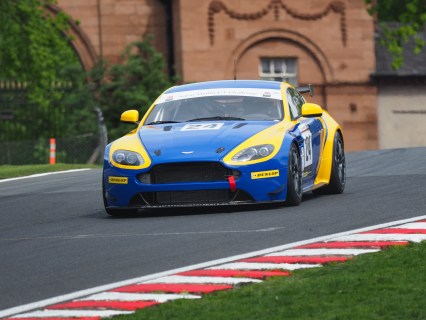 My camera, the Olympus E-M1 mk2, has one other killer feature – ProCapture. Whereas most cameras will focus on the subject when you half press the shutter, and then take one or more photos when you fully press it, Pro Capture starts recording as SOON as you half press the shutter, and ‘buffers’ or keeps the last 12 shots in its memory together with all those after you press the shutter, and these are then written to the memory card. So if you are shooting at one of the lower speeds, like 5 frames a second, you will get a couple of seconds worth of images BEFORE you make that final press of the shutter. How many times have we been looking through the viewfinder waiting for action to happen, like a bird taking off, but by the time we react to the movement, the bird has gone. This camera lets you go back in time!
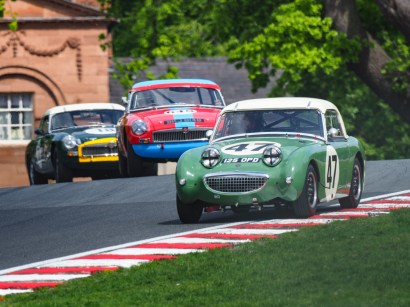 So last weekend I spent some time at a club motor race meeting at Oulton Park in Cheshire with those nice folks from Olympus UK Events. I already had my E-M1ii of course but was pleased to try both a 40-150mm Pro lens, and the 300mm f4 Pro lens (they were loaning out cameras too if anyone wanted to try those). A great opportunity to ‘try before you buy’ given that the 300mm lens is around £2000 to buy. Also on hand to help were Lewis Speight, one of the technical gurus from Olympus UK, and Mike Inkley, a pro sports photographer. So off we went trackside to record the cars that were racing that day – some modern sports/touring cars, but some classic sports cars too.
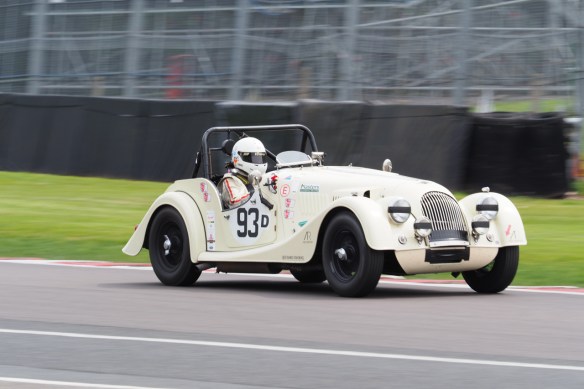 Lets just say that the equipment we were using was amazing – the ability to fill the frame and focus on fast moving cars from the other side of the safety barrier, and record bursts of up to 40 shots as the cars went past or crested the top of the hill at Lodge Corner! I did however fill a complete memory card during my morning session – over 3000 images – so needless to say sorting through these and picking the best from each sequence took some time!


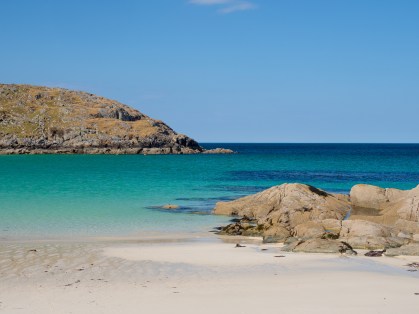
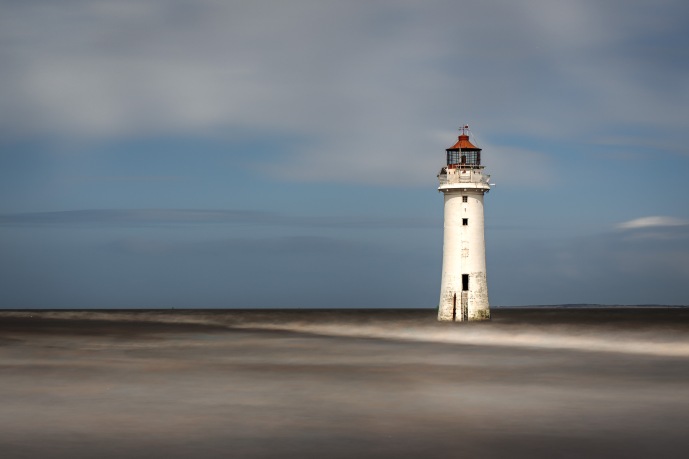
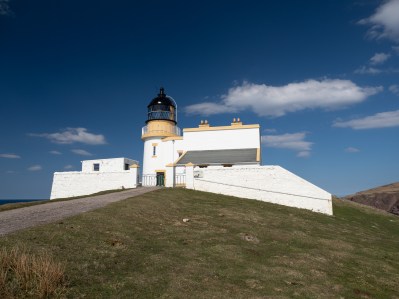 We next took a lengthy diversion to the lighthouse near Stoer Point – more great views and the option to walk the 2 miles to Stoer Point for the more adventurous. Very rural around here – lots of derelict farmhouses and agricultural machinery, and one (working) smallholding had a dead fox hung up on the fence by the house! Needless to say we didn’t hang around here for long…
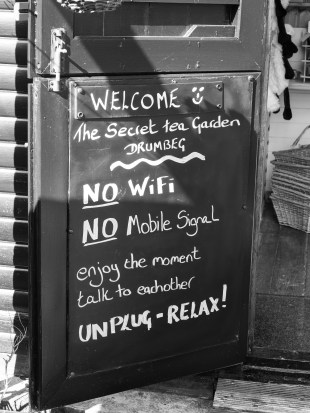 Getting peckish by then we were on the lookout for a nice spot for our picnic lunch (ordered from the hotel the night previous) and found yet another glorious beach, just by the side of the road at Clashnessie.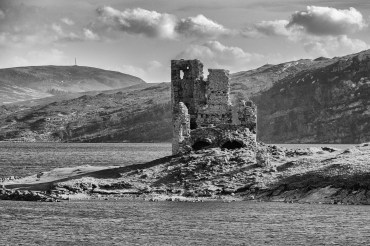
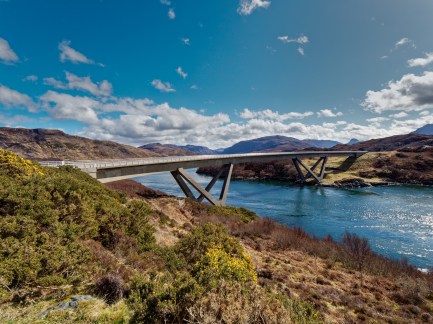 From here it’s up to Scourie, and although the beach was ‘so-so’, the rocky headland was well worth exploring and we saw many different sea birds.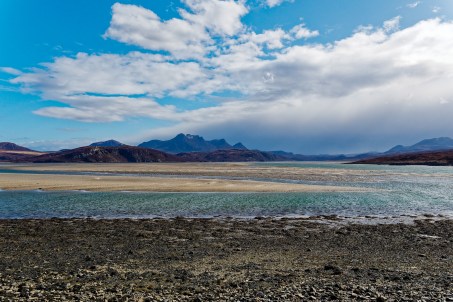


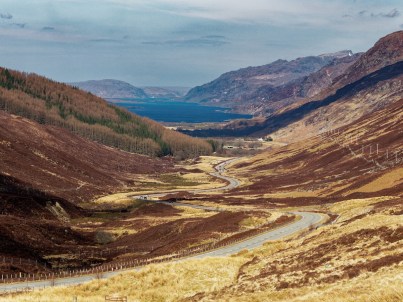
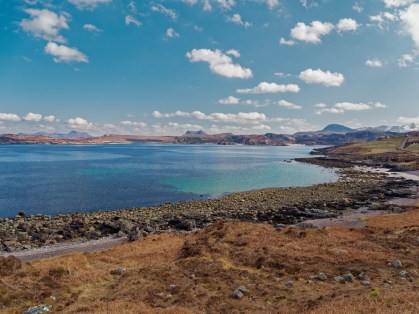
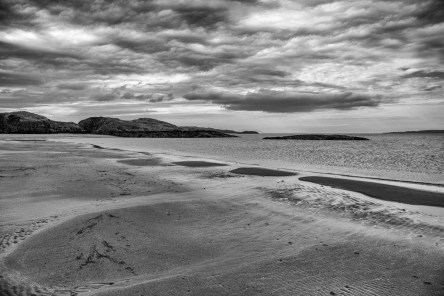
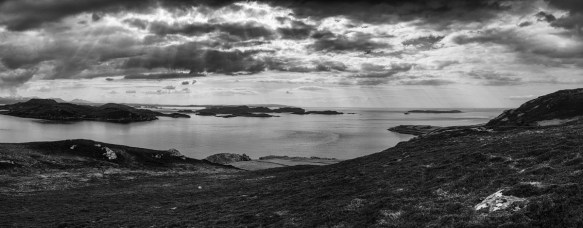

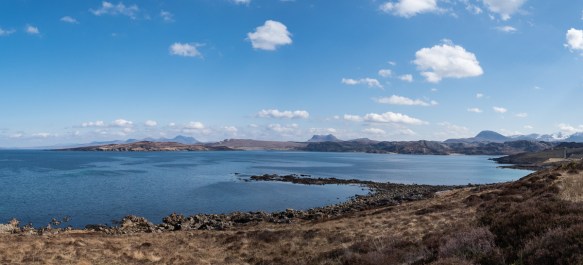


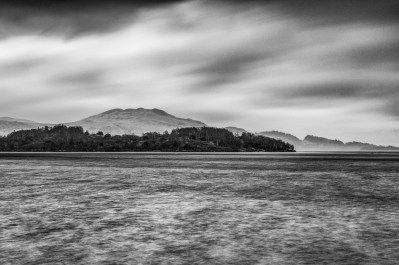
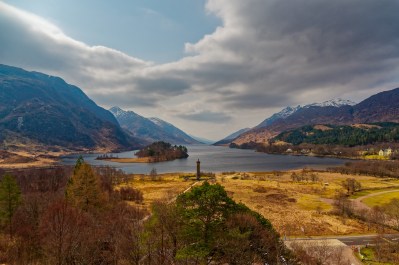
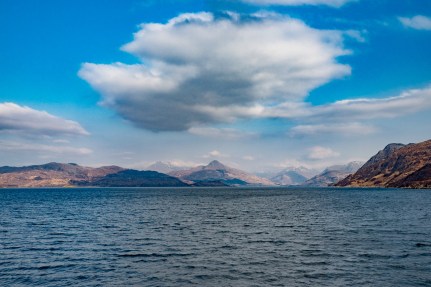
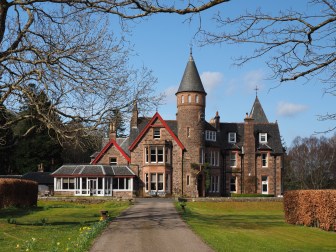
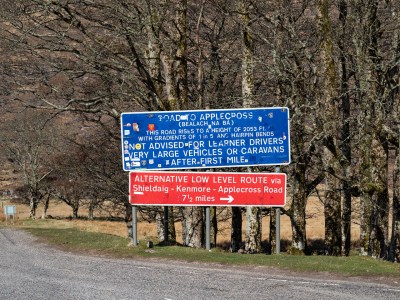
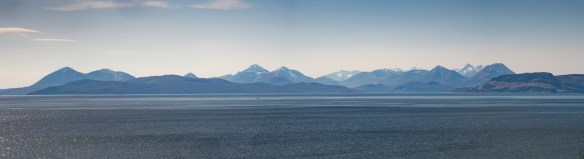 An amazing day, and one that completely surpassed our expectations. Roll on tomorrow, and Part 2!


 Nigel Young