It’s all about the light…

A flying visit to the Lake District this week yielded a couple of hours to get out with my camera.  The conditions were not, however, very encouraging – although the forecast was for ‘sunny spells’, it was raining when I parked at the Silverthwaite National Trust car park just off the Ambleside to Langdale road, and it was blowing an absolute hooley (the aftermath of Storm Henry.) Still, boots on and kit in hand I headed down to the path running alongside the River Brathay to see what was possible.
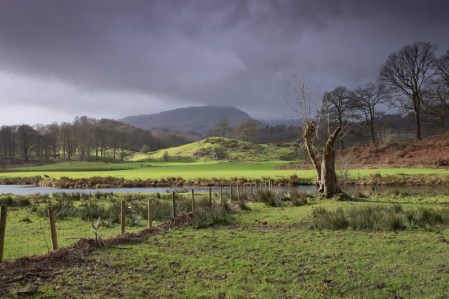
1602 langdale-14I had planned to try a couple of long exposure images using my new Hitech filter holder, but it was clear it was far too windy for sharp pictures, even with my heaviest tripod set as low as possible. The tops of the fells were shrouded in mist/cloud, but there were some brighter patches in the sky (nothing to actually call sun though…)  Anyway, I found a nice view with a fence as lead-in, and set up and waited. After about 10 minutes, it had pretty much stopped raining, and I was rewarded with a few breaks in the cloud. The foreground was nicely bathed in sunlight – only for a few seconds, but enough to get a couple of frames including this one.
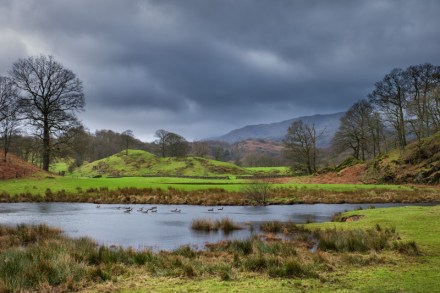
1602 langdale-4Wandering along looking for another view point, I spotted this family of ducks, and quickly set up.  Within a few seconds they had moved into the perfect position in the frame, and as luck would have it, another fleeting moment of sunlight brought the scene to life. Time for one shot only before the ducks had moved on, and the sun had disappeared again!

In the time left, I managed another couple of shots, but as before it was a case of finding something interesting, setting up, and then waiting (and waiting…), and hoping the light would come good.  I had quite a few strange looks from walkers passing by, and even a few comments about me just standing there waiting – everyone expects a photographer to be shooting all the time, but there’s absolutely no point if the light isn’t going to make the shot work. Sometimes waiting until the light is right pays off, but so often its a case of returning when the conditions are better. Patience is rewarded (but only sometimes!)

Here are a couple more I managed that morning.  All photos taken on my Fuji X-T1 camera with 16-55mm lens, Hitech filter holder with 0.9 ND grad filter, and Manfrotto 055 tripod. RAW images processed in Lightroom, and Viveza 2.
It Wasn’t Always Digital…

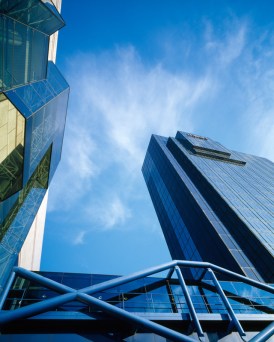
LE7-02101I suppose it’s easy to assume that photography only really got going with the advent of ‘digital’ – the easy availability of photos taken on smartphones and tablets, and relatively cheap and easy-to-use point and shoot cameras has revolutionised photography for the ‘man-in-the-street’. What you see is very much what you get, and cloud photo-sharing sites make sharing photos so easy.
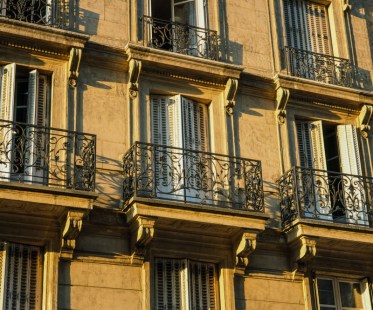
But photography as we know it – i.e. capturing an image, and being able to chemically or digitally reproduce it, has been going for close to 200 years now.  The first photographic images were captured on sensitised paper placed in a primitive light tight box, with the image focussed using a simple lens. As with most things man-made, the process and equipment developed and was improved, but it wasn’t really until the 1940s and 1950s that photography was within the reach of a wider public – until then it was sufficiently complex and expensive to ensure it was mostly only practised by professionals who of course could command a high price for the photos they provided.

LF7-03011Box Brownie and folding cameras taking roll film, together with the advent of consumer oriented processing labs really reduced the cost of photography, and the widespread adoption of 35mm film (originally developed for the movie industry) and cheap Far-East produced cameras really opened up the opportunities for everyone to take their own photos.

Roll and 35mm film was relatively cheap, and labs would process and print your holiday snaps in a few days for less than £10.00.  Enthusiasts were also catered for, with enlargements relatively reasonably priced. There was of course no way of knowing how or indeed whether your photos would turn out – there was always that moment of nervous anticipation when you picked your photos up from the lab, or they arrived by post!

Like most people, I love the immediacy of digital, the opportunity to re-shoot an image that doesn’t look quite right, the chance to enhance or improve it after the event, or to share a photo with friends or family. It doesn’t somehow have quite the ‘magic’ of film though does it?

These are just a small selection of my images from the ‘pre-digital’ age – all were taken on Fuji Velvia slide film on a 6x7cm Mamiya rangefinder camera and have been scanned to add them to this blog.

This slideshow requires JavaScript.

Liverpool #Streetlife Photos

While street photography isn’t really my genre, I couldn’t turn down the opportunity to go on the free #Streetlife ‘photo walk’ in Liverpool sponsored by FujiFilm and Clifton Cameras, and lead by Matt Hart. I’ve a lot of time for Matt’s work, and never really explored Liverpool, so far too good an opportunity to miss.

A bright sunny early autumn day saw close to 100 photographers of all ages turn up at the Albert Dock, sporting everything from Fuji CSC cameras, big Canikon DSLRs, right down to just iPhones and iPads. After a brief intro by Matt, we all set out along the waterfront, but quickly split up into smaller groups as we roughly followed the preset circular route, taking in highlights like Bold Street, the ‘bombed out church’ (St Lukes) and the beautiful Georgian Quarter. We didn’t stay too long around Lime Street Station as there was a political demonstration going on that could have turned nasty, so headed on past the Central Library, the shops of Liverpool One, and back to the waterfront area – in total a very enjoyable 4 miles or so, over 6 hours.  All in all a great day out, and I have a good number of photos I’m happy with – mostly ‘characters’ but also some cameo shots of some of the buildings and sights in a fine city.

This slideshow requires JavaScript.

I don’t think there’s any doubt that I will be back to Liverpool again soon!

EDIT – all photos taken with the remarkable 90mm f2 Fuji XF lens and X-T1 camera.

Thoughts On My First Photo Exhibition

After a long wait, and quite a lot of work, my first ever solo photo exhibition is now up and running (runs to 9th May 2015).  Details at http://www.nigelyoung.co.uk/exhibition

OK, so it’s not a big venue in New York, London or Paris, but it’s a start – it’s at our local Community Arts Centre here in Market Drayton, Shropshire, UK.  They have a gallery area that local artists and photographers can book for a 3-week exclusive exhibition. Its completely free of charge, and the space available – 2 long walls, will take around 30-35 decent sized photographs. The audience is obviously friends and family, and of course the mainly local residents who use the facilities like the cinema, and education, fitness and leisure classes. I don’t claim to be a great photographer – years of practice does NOT make perfect, but an exhibition is something I’ve always wanted to do, and this opportunity was a no-brainer

Yesterday was pretty hectic – getting all the mounted prints hung level, labeled, and the supporting promo material setup, so I didn’t really get chance to appraise how it looked.

Today, however, I went back to the venue (with a relative who was keen to see my pix) and it was a really emotional experience – I guess we look at our individual images time and time again on the computer, but there is nothing, believe me, that compares with seeing a set of 30 good-sized prints of just one’s own work up on the wall!

Although I’ve been taking photos for a long time (the oldest image on show dates back to 1974!), I’ve always favoured landscapes with maybe a few architecture/urban images included, and don’t often take photos of people.  I did include some street/people photos in the exhibition, mainly to add some variety. What really struck me today was how compelling the ‘people’ photos are compared to landscapes and urban scenes – I constantly found myself drawn back to the photos of people, rather than landscapes.

So now I find myself more confused than ever – I was planning to ‘rationalise’ my photo interests to landscapes, and maybe some building/urban scenes, but am now questioning whether people photos are the way to go (for me…) I don’t feel a particular affinity for photographing people, and don’t even feel I’ve got a flair for it, but if I get satisfaction looking at the results, isn’t that enough?

I’m really interested to know whether fellow photographers struggle to define what ‘kind’ of photographer they think they are?

Here are a few of my favourite photos from the exhibition…

This slideshow requires JavaScript.

EDIT: Festival Drayton Centre have extended the exhibition until 30th May 2015 – yippee!

Worth getting up early…

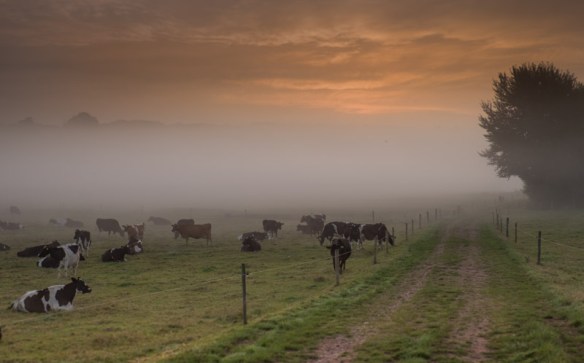
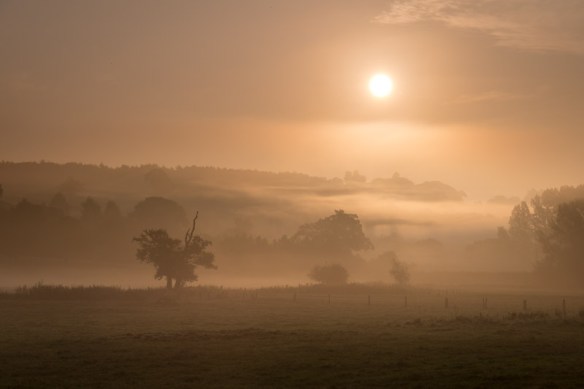
The fact that dawn and sunrise are now just a little later means it’s not quite such an effort to get out and take photos in the rather special light that morning brings. We are lucky that we live on the edge of a valley where the early morning mist collects, and it was really only a short walk down to the fields where the cows were grazing as the sun came up.

XT101093

These cows seemed to think I was bringing breakfast!

No tripod, I just relied on being able to use the camera at higher ISO and still get good results. Even before the sun came up, there was a pretty big difference in illumination between sky and foreground, so most of these shots use a 0.6 (2 stop) grad filter to balance the exposure.  I’m more than happy to take several shots with different exposures and blend them when using a tripod but handheld really does need a bit of help at source.  Even so, the shots with the sun in the frame needed a little Lightroom magic to get the tones and balance just right…

Misty Morning

The mist weakens as the sun rises – 10 minutes later it had all gone!

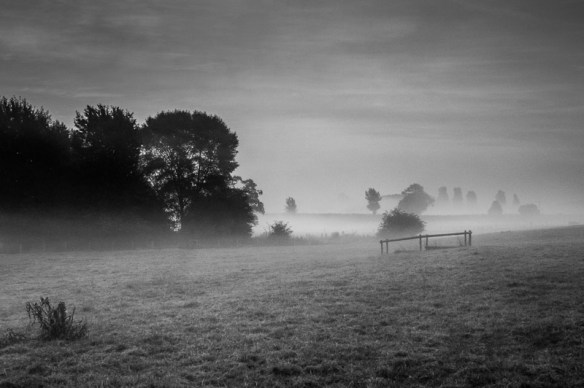
Even before the sun makes an appearance there are great tones, although again they need a little work to bring out the best contrast.

XT101087

Converted to mono, but there wasn’t much colour going on this early anyway!

It was definitely worth getting up for these photos!

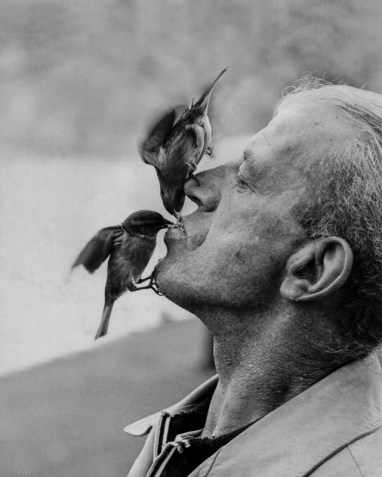
Feeding the Birds, in 1974!

AN74XX-1

Nikkormat FTn – Ilford FP3

Yes, 1974 or thereabouts, I can’t remember the exact date. Taken on a trip to London, I think on my old Nikkormat FTn camera, probably with a Nikkor 105mm f2.5 lens and FP3 film. The negative perished years ago but I found a very damaged and torn 10×8 print a couple of years ago, scanned it, and spent hours restoring it.

One of our friends back in the 1970s was Chief Photographer at the local newspaper (the Wolverhampton Express & Star), and managed to get the photo published for me. I got a series of calls from other newspapers, and it eventually made it into the Daily Telegraph and a couple of other UK dailies via a picture agency.

One day I received a call from the London ‘stringer’ for the Florida-based National Enquirer who was interested in publishing the photo in the US. (Interestingly, his name was Fred Pye, and at the time married to the singer Kathy Kirby…)  I think I got paid $50 (a lot of money then!) for them to use the photo  – its the only photo I’ve ever been paid for… lol

Take a walk…

My dear wife spotted a FREE photo walk at the Dudmaston National Trust property in Shropshire (UK) and encouraged me to try it. I am so glad I did!

Accompanied by a volunteer photographer at the estate, a bunch of around 12 of us walked around the site for a couple of hours while he pointed out things of interest and good viewpoints. All this was at a leisurely pace, so even though I was the only one using a tripod, it didn’t seem rushed.  It wasn’t the best weather/light – around midday in September, cloudless sky and slightly hazy, but this was fine for the woodland shots, and needed a bit of post-processing to bring out contrast in the wider more open views.

XT101188

Taking it easy…

I really enjoyed using the Fuji 18-135mm lens – its a fair bit heavier than my ‘old’ 18-55mm, but I only switched lenses once during the day (and that was to a wider angle lens).  There’s been talk about this new lens not being as sharp as the 18-55mm, but so far it works for me.

All in all a great session – well lead by volunteer Matthew, a good venue, and minimal cost, just the standard £6.60 entrance fee to the property.  Definitely worth looking for other similar events – there are several over the next few months in the Shropshire/Cheshire area.

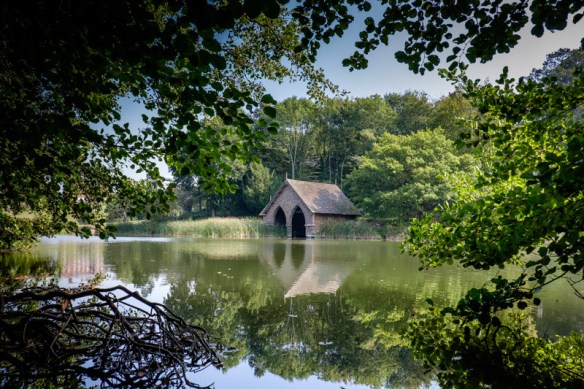
Boathouse - Dudmaston NT

The  boathouse at Dudmaston

Dudmaston is situated on the A442, approx 3 miles south of Bridgnorth, and is run by The National Trust.

Do I need graduated filters?

There’s a groundswell of opinion that the way to deal with the extremes of contrast in sunset and sunrise images in particular is to use a graduated ND filter. The principle is simple – set the filter so the darker part covers the brightest part of the image – usually the sky, and this then ‘holds back’ the light, giving a more balanced image. Sounds simple, but not so easy in practice. A tripod is essential to hold the camera still while the filter is correctly placed. That’s after you’ve worked out how strong a filter to use, and whether its a hard ‘grad’ (i.e. a quick transition from light to dark) or a soft ‘grad’ if a gentler transition is required. There’s also the small matter of carrying around the filters (up to 6 in a set) and the holder and adapters for different lenses, not to mention the cost of the filters themselves – could be £200 +.

Most decent digital cameras allow you to store the RAW image from the chip, and its generally possible to get quite a decent dynamic range by careful post processing – however with a really wide exposure range like the image below, that’s still not going to do the trick.

A very practical alternative is ‘exposure stacking’ – take one image exposed for the lighter parts of the scene (the sky here) and another exposed for the darker foreground detail. Then combine the two images in a programme like Photoshop to take the best bits of both. The image below was from images with 5 stops difference in exposure – far more than even grad filters could easily copy with, and was merged together in just a few minutes. Its a really practical way to cope with wide exposure differences – just remember to use a tripod so the 2 images correspond!

DX121021-60

EDIT: Since writing this blog back in May 2014, I’ve actually invested in a set of grad filters. I don’t use them that often as its possible to wring a lot of detail out of Fuji RAW images, but there are times when they definitely help.