To quote an old saying – ‘the best camera is the one you have with you’. For most of us the camera we usually carry around is the one in our smartphone, and to be fair, they are pretty good these days. But for us self-styled photographers, the tiny sensor and limited functions in smartphones just don’t cut the mustard. We want a sensor that will support at least a high quality A3 size print, a superb quality wide aperture lens, RAW file capability for editing, and of course high ISO sensitivity without image noise that looks like marbles. And a few other features would be nice too… No smartphone offers all this – the tiny sensor and limited space for processor chips just makes that a no-no.
Sure, there are plenty of compact cameras that offer the larger file sizes and options, but find one that has the required image quality, and is still genuinely pocketable? No – either the image quality isn’t there, or they are just too big to slip in a trouser pocket… so they get left at home. There are so many occasions when I wished I had a decent camera with me instead of it being on a shelf at home. For me, the closest to this elusive beast is the Ricoh GR Digital (actually, in days gone by, I had a GR film camera and that was truly special) but I was put off buying a GR because of their reputation for dust ingress – no point in having a super-pocketable camera if you have to keep it in a bulky case all the time to protect it is there? I had a Fujifilm X100T camera for a while, but it was just a little too big to be properly pocketable, so again, it frequently stayed home.

The new Fujifilm X70
So yesterday, Sarah from Cambrian Photography loaned me the newly launched Fujifilm X70 camera to try for a few hours while we wandered around Liverpool on our Fujiholics Photo Walk. The camera has been described in the photo press as a ‘cut-down’ version of the X100T, and it definitely has Fuji genes – it does indeed show a marked similarity to the X100T, but in a smaller form factor and without the viewfinder. All the other Fuji X-series hallmark features are still there though – the superb APS-C sized sensor that powers the X-T1 and X-T10, combined leaf and electronic shutter, processing engine and AF from the excellent X-T10, a newly developed 18mm f2 lens, and Fuji’s excellent build quality. It feels like a Fuji camera. Ah, and did I forget to mention, that LCD screen on the back can flip right round to 180° AND is a touch screen – not only can you adjust the AF target point using the touch screen, but you can fire the shutter too – very handy. This isn’t a detailed review of the camera and all its features so I won’t bore you with the whole specification – here is the link to the Fuji website.
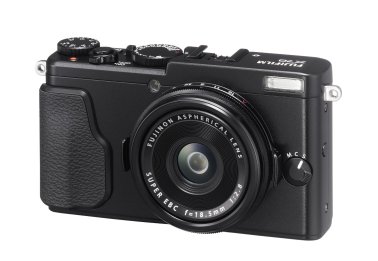
Cool but still retro – a black X70
I have to say my first reaction when I handled the X70 was a little muted – it wasn’t quite as small as I had imagined it was going to be, and the first few times I shot with it, I raised it to eye level before realising it didn’t have a viewfinder – just the LCD screen on the back. Not sure how my less than perfect eyesight was going to manage that (there is an optional optical viewfinder that fits in the accessory shoe, but I didn’t fancy that). It definitely fits in jeans or jacket pocket though… But, it felt good in the hand, all the controls and menus felt familiar, the AF is quick, very quick, and like all Fuji cameras, when it does find focus, it is deadly accurate. Even reviewing my first few shots on the screen, I could see they were going to be sharp.
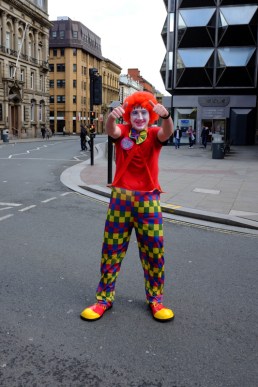
Happy chappy!
The Photo Walk in Liverpool was all about street photography, capturing those little cameos of people and the city but without drawing attention to yourself, and I found I was increasingly reaching for the X70 rather than the X-T10/35mm combo I had with me. I could reach into my pocket, switching the camera on at the same time, and be ready to shoot immediately. I found I took quite a few shots from waist level, using the flip screen, and that too worked well. For some shots the 18mm lens of the X70 was a little wide, but mostly I preferred it to shooting with a longer lens, and with 16Mp, there is the option of cropping and still getting a great image. (The camera has a ‘crop’ image option, but I didn’t try that on the day..) Another feature I loved was the electronic shutter – switch to that and turn the other camera sounds off, and its completely silent – great for close-up candids.
Of the 60 or so shots I took during the day, there wasn’t one where the exposure was significantly wrong, and the 3-4 shots that weren’t sharp were down to subject movement or me ‘snatching’ as I took the photo. All the images (I didn’t even change the base settings on the camera, so all were colour JPEGs) were bright and crisp and useable straight from camera. The lens is definitely very sharp, and there is no obvious vignetting or quality fall off at the edges. With that lens, sensor and processing engine, any images are clearly going to be of comparable quality to those from an X-T1, X100T or X-T10 so no compromises there. Handling of the camera is great, and while the lack of a viewfinder may be a problem for some, the flip/tilt LCD screen is a very useful feature. The field of view of the 18mm lens is incredibly useful, and the ability to focus as close as 10cm is great too.
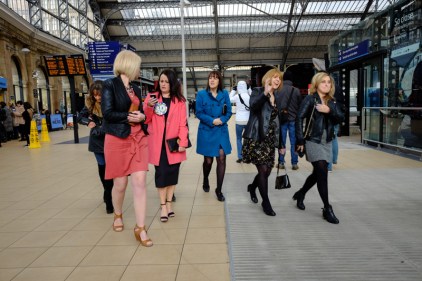
Girls out on the town
So during the day, the camera grew on me, and I went from ‘nice, but not for me’ to ‘when can I have one’. The launch price of £549 is pretty much to be expected for the quality and features on offer, but I would expect some softening of the street price over the next few months. Expect to see it at maybe £475 to £499 by the end of this year, at which its a definite purchase for me. Don’t forget to carry a spare battery though – the battery in mine was flat after a day’s shooting.
Here are some more images from the day (and BTW, I’d definitely recommend trying one of the Fujiholics Photo Walks – great fun, great company, and FREE – and you don’t have to use a Fuji camera either, although you’ll probably end up buying one afterwards!)
This slideshow requires JavaScript.
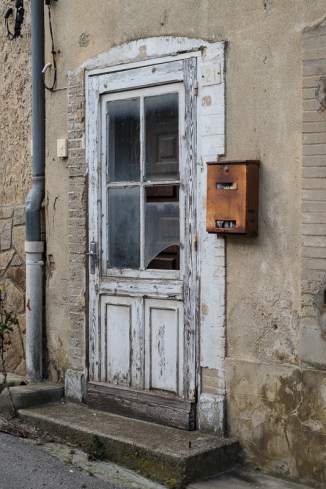 Our little village in France (Montréal, near Carcassonne, in the South West) has a history dating back over 1000 years to Cathar times, and has a pretty eclectic architectural heritage. The Collégiale, or main church, dates back to the late 13th century, although it is thought a primitive church existed here several hundred years before that. Much of the surrounding village was burned to the ground by the Black Prince in 1355, and the next 400 years saw the village repeatedly attacked as a consequence of the religious strife that dominated this part of France. As a result, many of the older houses in the village date back to the 17th and 18th centuries and these sit alongside houses that have been modernised since, often in a haphazard fashion. There are barely a handful of completely new houses in the main part of the village – all the new development has been carried out further afield.
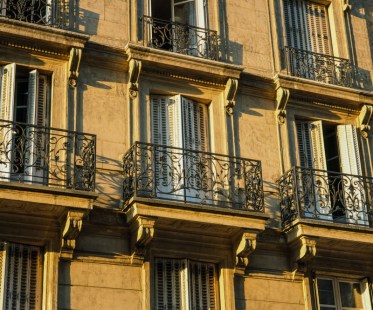
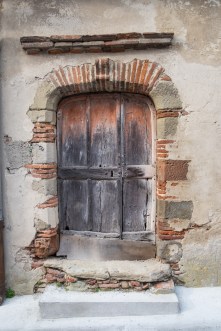 The somewhat diverse architectural styles in the village are reflected in the doors – not just to the Collégiale and the grand houses in the village centre, but all the smaller houses too. Every time I walk around the village I marvel at the sheer variety of styles of door on show, so for a bit of fun decided to do a mini photo project, recording as many of the different doors as I could. Camera used was (as it often is these days) the Fujifilm X-T10, this time with the 18-55mm zoom. No special technique here – just walk up, select a nice view of the door/doorway – often from the side as the streets are too narrow in some cases to use even the 18mm front-on. Photos are all RAW images, imported into Lightroom with a little ‘punch’ added, and some judicious cropping and further adjustment where needed. Here are a few of my favourites from my mini-project.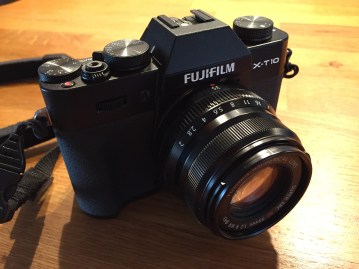
 Encouraged by attending a couple of excellent workshops and photo walks with
 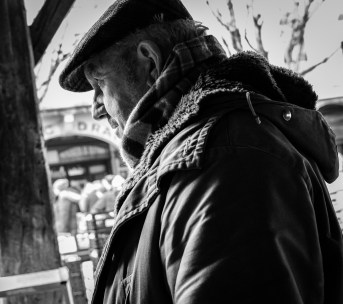 Shooting at street markets in France is a case in point – French people, in my experience, are not at all keen on candid photos. Whether its a national sense of privacy, or because some of the traders at the markets are working ‘on the black’, I don’t know, but be prepared for some hostility if you are seen overtly photographing them!
 I took this rig out this weekend to shoot the lively Saturday market in Revel in the
  #1. Interested in getting the new 35mm f2 Fuji lens, I saw it advertised online at Digital Depot. As I was keen to get it asap, and passing relatively near their Hitchin store, I ordered it for collection next day. Come the day, and just before I swung off the M1, I thought I’d give them a quick call to check all was ok. “Ah”, said the man, “we don’t actually have them in stock, but I can call you when we get them in….” So I asked why they were showing them as in stock – “well, we don’t actually link our online stock with our shop stock, so I guess we must have sold out in store…” Tried to explain that it wasn’t really on to advertise something as in stock, when it wasn’t, but it fell on deaf ears. Needless to say I bought the lens elsewhere, and probably won’t try Digital Depot again.
 #2. I received an email from Stafford Audi suggesting it was time to get my car serviced, and inviting me to book online. Duly did that, selecting a date a few days on, and got a response indicating they would shortly confirm my reservation. Surprised to receive a call next day to say that day wasn’t available, and indeed the first available date with pickup and collection was a month hence! Tried to point out how frustrating this was, but again, it fell on deaf ears….
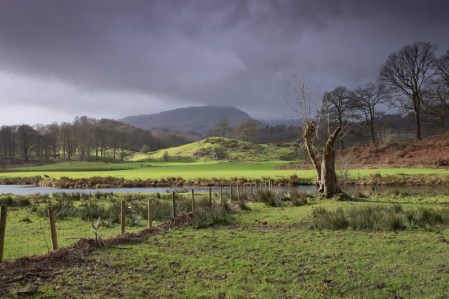 I had planned to try a couple of long exposure images using my new Hitech filter holder, but it was clear it was far too windy for sharp pictures, even with my heaviest tripod set as low as possible. The tops of the fells were shrouded in mist/cloud, but there were some brighter patches in the sky (nothing to actually call sun though…) Anyway, I found a nice view with a fence as lead-in, and set up and waited. After about 10 minutes, it had pretty much stopped raining, and I was rewarded with a few breaks in the cloud. The foreground was nicely bathed in sunlight – only for a few seconds, but enough to get a couple of frames including this one.
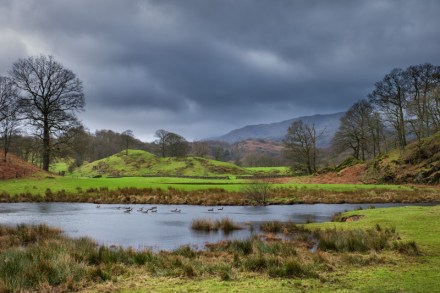 Wandering along looking for another view point, I spotted this family of ducks, and quickly set up. Within a few seconds they had moved into the perfect position in the frame, and as luck would have it, another fleeting moment of sunlight brought the scene to life. Time for one shot only before the ducks had moved on, and the sun had disappeared again!


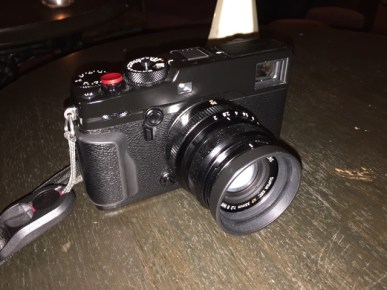


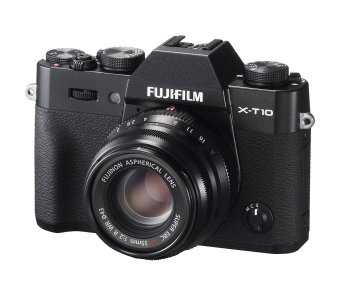
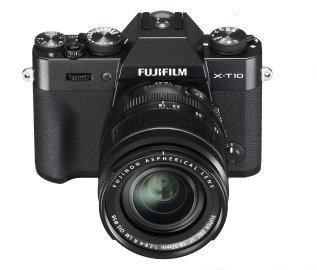 When the X-T10 camera was launched in late 2015 it was dubbed by many as a ‘cut down X-T1’, stripped of many of its features. Having bought one a few weeks ago, that seems to be far from the truth! Sure it is smaller, it doesn’t claim to have the weather proofing that its big brother has, and both the LCD and viewfinder screens are a little smaller, but it really is an exceptionally good camera, at around half the price of the X-T1!
 no issues there – the image quality is identical. There are the full range of image quality and shooting controls, a tilt LCD screen, face detection and continuous AF, and even a built-in flashgun. Apparently the time to store a burst of photos is slower, but as I see it that is really only an issue if shooting sport or similar.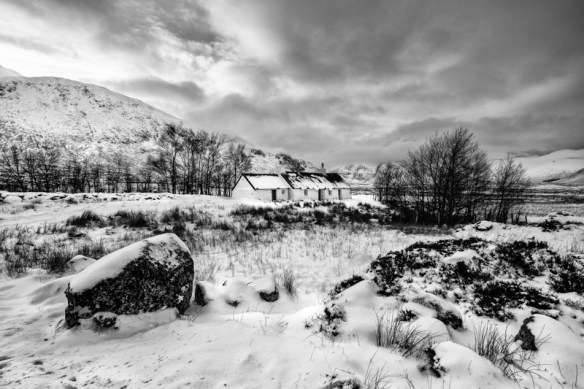
 I suppose it’s easy to assume that photography only really got going with the advent of ‘digital’ – the easy availability of photos taken on smartphones and tablets, and relatively cheap and easy-to-use point and shoot cameras has revolutionised photography for the ‘man-in-the-street’. What you see is very much what you get, and cloud photo-sharing sites make sharing photos so easy.
 Box Brownie and folding cameras taking roll film, together with the advent of consumer oriented processing labs really reduced the cost of photography, and the widespread adoption of 35mm film (originally developed for the movie industry) and cheap Far-East produced cameras really opened up the opportunities for everyone to take their own photos.

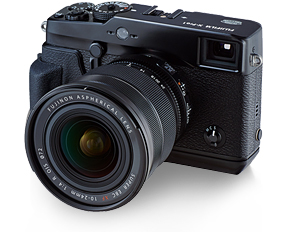 Much as I love my Fuji prime lenses, particularly the 14mm and 23mm, there are times when a nice wide zoom would be so useful. Sometimes 14mm just isn’t wide enough to get everything in shot, and there’s no opportunity to step further back. Likewise you may want to stay close to a foreground subject and get more background in. And there’s the ‘zoom’ thing – its all very good saying ‘ah well, don’t be lazy, just take a moment to change your lens over’, or ‘stand further back’ – that’s not so easy if you are standing in the middle of a mountain stream. Likewise if its blowing a gale you don’t want dust getting into your precious camera body, or to faff around switching filters over from one lens to another. If you are a documentary rather than landscape photographer, those few seconds changing a lens can mean missing that shot.
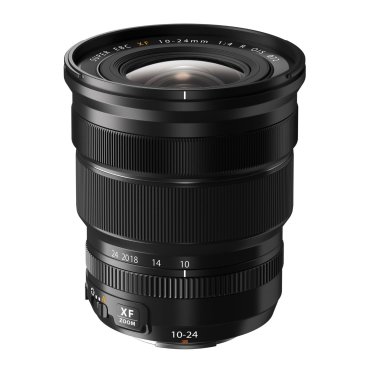 Ah, the first real problem… The 72mm filter size does mean I can fit my Lee Seven5 filter system on, but alas, at anything wider than the 14mm setting there is vignetting – i.e. the edges of the filter holder come into the edge of the shot – its then pretty much unusable with the Lee polariser fitted. Not great, but not the end of the world, as there’s always the option to use round 72mm filters – more money and more to carry around, and of course no graduated filter option.
 Nigel Young